SEBI Board Meeting: Key Regulatory Developments from the 214th Board Meeting
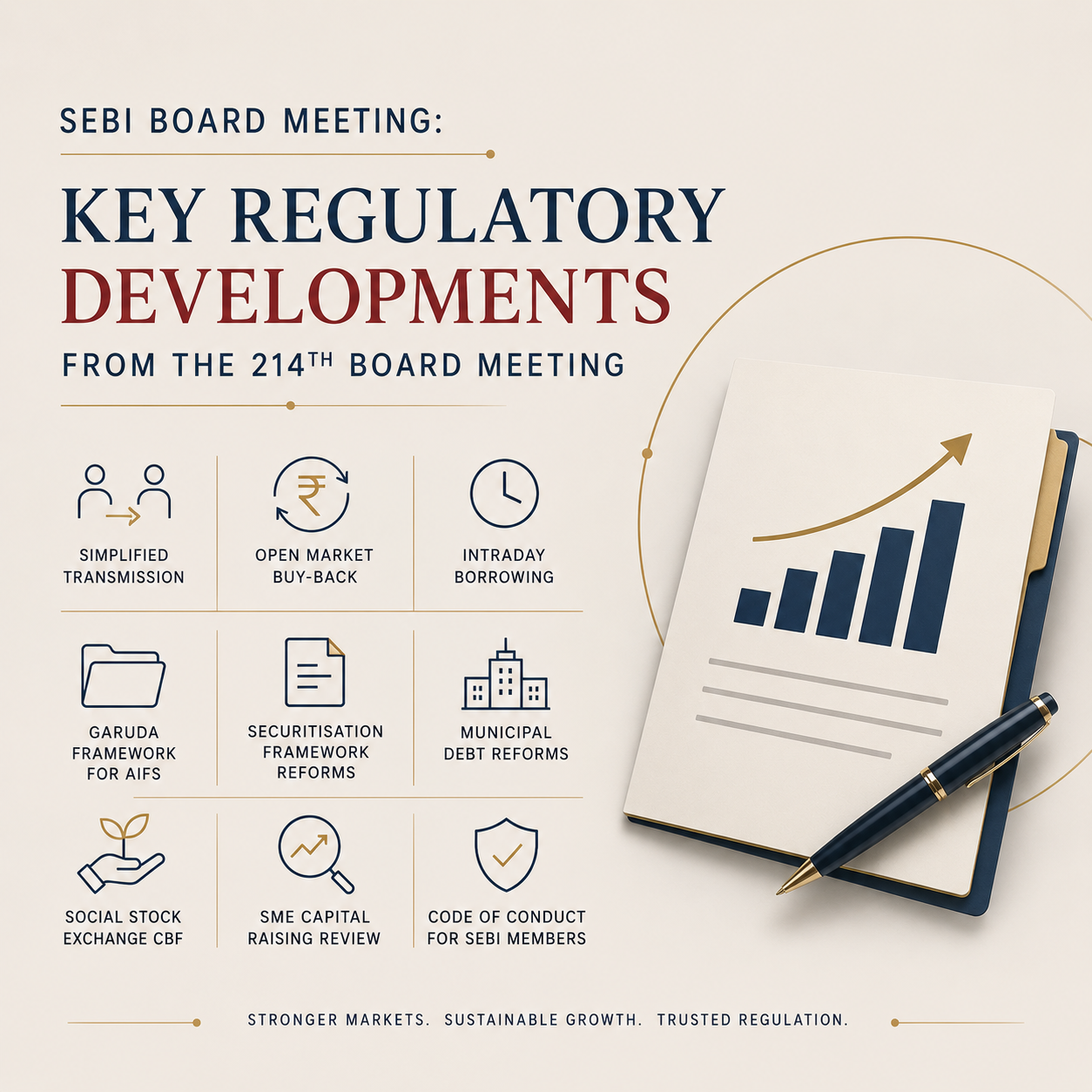
The 214th Board meeting of the Securities and Exchange Board of India held on 19 June 2026 approved a broad set of reforms affecting listed companies, Alternative Investment Funds, mutual funds, securitisation markets, municipal bonds and investor servicing. The decisions collectively indicate SEBI’s continued focus on ease of doing business, market deepening and operational efficiency, while preserving core investor protection safeguards.
Set out below are the key regulatory developments.
- Simplification of Transmission of Securities
SEBI approved significant reforms to simplify transmission of securities to legal heirs and claimants of deceased investors.
Key changes include:
- Introduction of Quick Transmission Processing (QTP) for small-value claims:
- up to ₹10,000 for physical holdings
- up to ₹30,000 for demat holdings
- Enhanced thresholds for simplified documentation:
- Physical holdings: increased from ₹5 lakh to ₹10 lakh
- Demat holdings: increased from ₹15 lakh to ₹30 lakh
- Procedural simplifications:
- removal of mandatory PAN submission in certain cases;
- removal of mandatory probate of will;
- combined affidavit-cum-NOC permitted;
- QR-coded death certificates accepted;
- simplified verification for foreign death certificates.
These reforms are aimed at reducing procedural hardship and accelerating claim processing.
- Re-introduction of Open Market Buy-Back Through Stock Exchanges
SEBI approved amendments to the Buy-Back Regulations to reintroduce open market buy-backs through stock exchanges, effective 1 August 2026.
Key changes include:
- completion within 66 working days;
- minimum 40% fund utilization during first half of buy-back period;
- promoter holdings frozen at ISIN level during buy-back;
- mandatory compliance with minimum public shareholding norms;
- appointment of merchant banker made optional.
The reintroduction follows changes in the taxation framework and marks a significant recalibration of the buy-back regime.
For our detailed analysis of the structural and compliance implications of these reforms, please see our earlier article on SEBI’s buy-back amendments here.
- Intraday Borrowing Permitted for Mutual Funds
SEBI approved amendments to the SEBI (Mutual Funds) Regulations, 2026 permitting intraday borrowing by mutual funds to manage temporary liquidity mismatches.
Permitted use cases include:
- settlement timing mismatches,
- forex settlement obligations,
- mark-to-market payments on derivatives,
- other intraday liquidity gaps.
Safeguards include:
- borrowing capped by receivables expected during the day;
- mandatory repayment by end of day;
- prohibition on using borrowing for leverage;
- board-approved policies and documentation.
This provides operational flexibility for AMCs while ensuring prudent liquidity management.
- GARUDA Framework for AIF Scheme Launches
SEBI approved GARUDA (Green-Channel: AIF Rollout Upon Document Acknowledgement) under the SEBI (Alternative Investment Funds) Regulations, 2012.
Key changes:
- Regular schemes may now launch within 10 working days.
- Accredited Investor-only schemes may launch immediately upon filing.
- Angel Funds receive similar launch flexibility.
- Merchant banker intermediation is relaxed for specified categories.
The reform materially reduces scheme launch timelines and is likely to improve capital deployment speed for private market strategies.
For our detailed analysis of GARUDA and its implications for AIF managers, please see our earlier article here.
- Amendments to Listed Securitisation Framework
SEBI approved amendments to the SEBI (Issue and Listing of Securitised Debt Instruments and Security Receipts) Regulations, 2008 to align the listed securitisation framework with the RBI securitisation regime.
Key changes include:
- permitting single-asset securitisation for RBI-regulated entities;
- shifting certain disclosure obligations from originator to servicer;
- revised SPDE governance norms;
- clarification on same-group securitisation transactions;
- empowering SEBI to appoint a replacement trustee instead of winding up transactions.
These amendments are expected to support development of India’s listed securitisation market.
For a detailed breakdown of these amendments and their structured finance implications, please see our earlier article here.
- Municipal Debt Securities Reforms
SEBI approved amendments to the SEBI (Issue and Listing of Municipal Debt Securities) Regulations, 2015 to promote development of the municipal bond market.
Key changes include:
- permitting fund raising for refinancing existing project debt;
- enabling issuance through pooled finance vehicles involving multiple municipalities;
- encouraging retail participation by permitting lower denominations;
- allowing incentives such as additional interest or discounted issue price for specified investor categories;
- relaxation in post-issue disclosure timelines.
These reforms seek to improve capital access for urban infrastructure financing.
- Social Stock Exchange Capacity Building Fund
SEBI approved transfer of funds, administration and management of the Capacity Building Fund (CBF) for the Social Stock Exchange from National Bank for Agriculture and Rural Development to SSE-CBF, a Section 8 company established specifically for capacity-building initiatives within the SSE ecosystem.
- SME Capital Raising Selected for Regulatory Review
SEBI’s External Experts Advisory Committee recommended and the Board approved, “Assessment of the framework for SME Capital Raising in Securities Markets” as the theme for an evidence-based regulatory review for FY 2026–27.
This indicates continued regulatory attention on the SME capital markets ecosystem.
- Code of Conduct for SEBI Members
SEBI approved a new Code of Conduct for Members of SEBI, 2026, along with amendments to the SEBI Employees’ Service Regulations.
These changes follow recommendations of the High-Level Committee on conflict of interest, disclosures and governance-related matters.
The reforms aim to strengthen institutional governance and conflict-management standards within SEBI itself.
Conclusion
The June 2026 Board meeting reflects SEBI’s continued emphasis on market development through calibrated deregulation. Across buy-backs, AIFs, mutual funds and securitisation, the regulatory direction appears consistent: reducing procedural friction, improving operational efficiency and enabling faster capital formation, while retaining strong governance and disclosure safeguards. Several of these reforms, particularly those relating to buy-backs, GARUDA and securitisation, carry significant implications for market participants in capital markets, private credit, structured finance and alternative investments.
Disclaimer: The views expressed herein are solely for legal research purposes and do not constitute legal opinion, legal advice, solicitation, or professional guidance of any nature. The views are personal to the author and do not necessarily reflect those of PJ Law Offices (www.pjlaw.in), its principal, representatives, associates, retainers, affiliates (collectively, “PJLaw”). Readers are advised to seek independent legal counsel before acting on any information contained herein. PJLaw makes no representation or warranty, express or implied, regarding the accuracy or completeness of the contents and expressly disclaims all liability arising from reliance upon or use of the same.